The wash line as a service
Four levels, documented records, per-unit pricing.
The plant
Everything this company does happens on one site in East Austin. Here is what is on it, what each machine is for, and where the water goes afterwards.
Order desk
Tell us whether you want to look around or get containers processed, and roughly when. Both start on the same form.
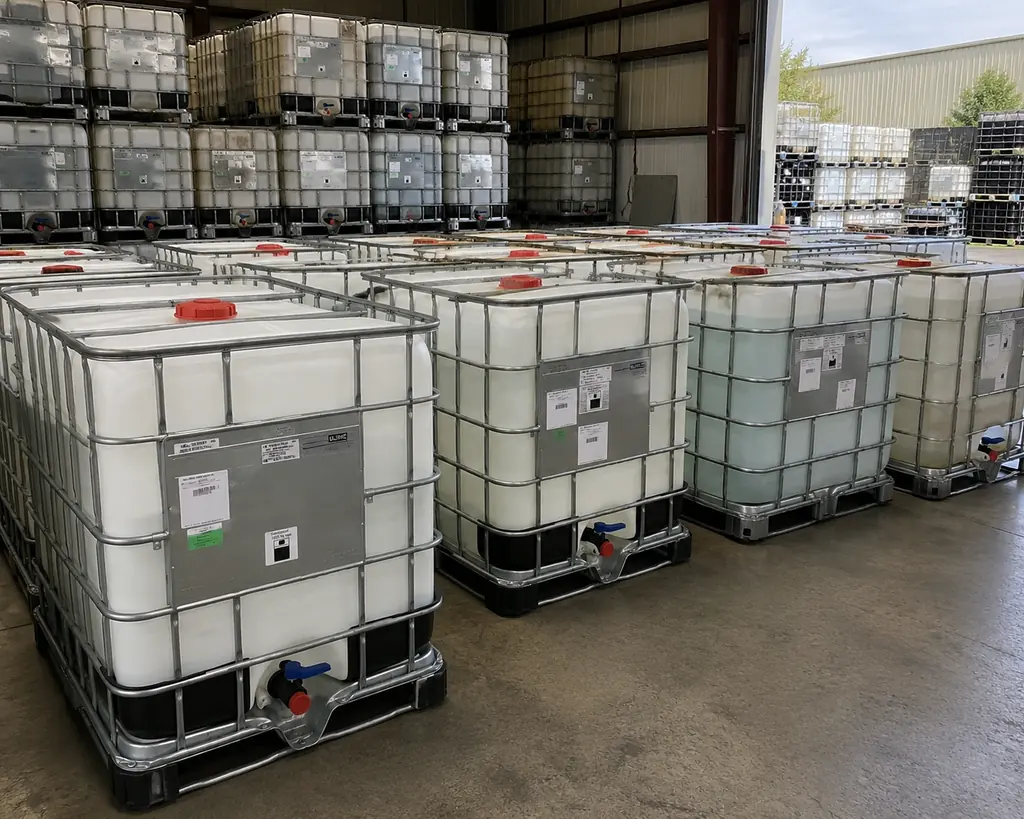
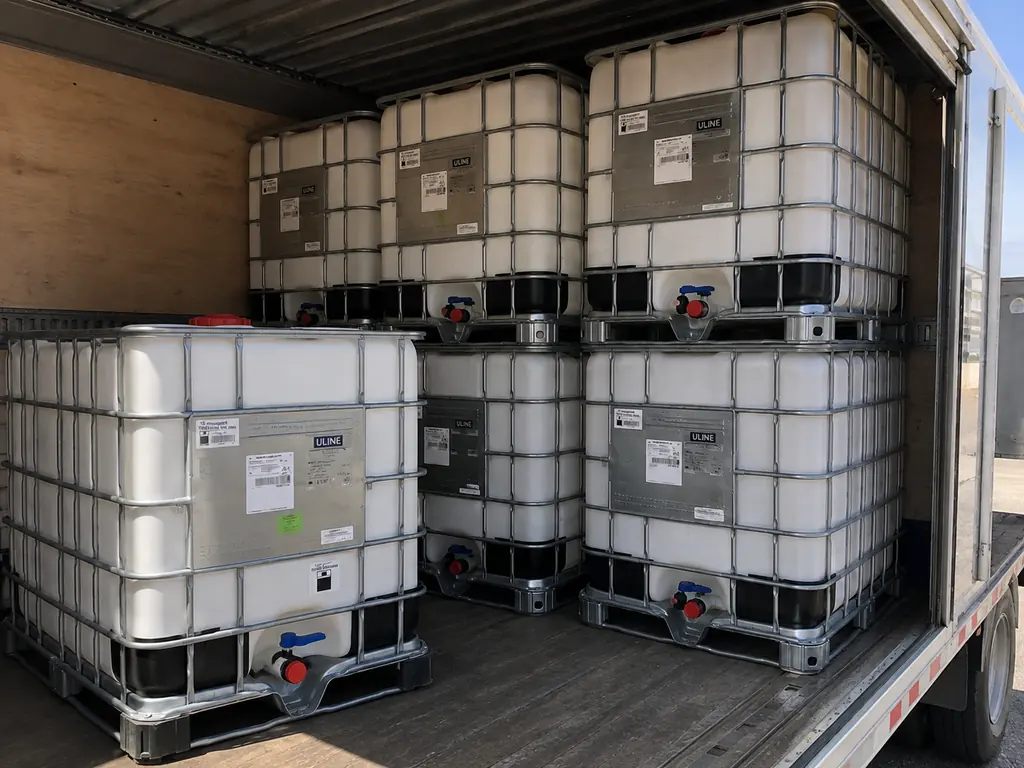
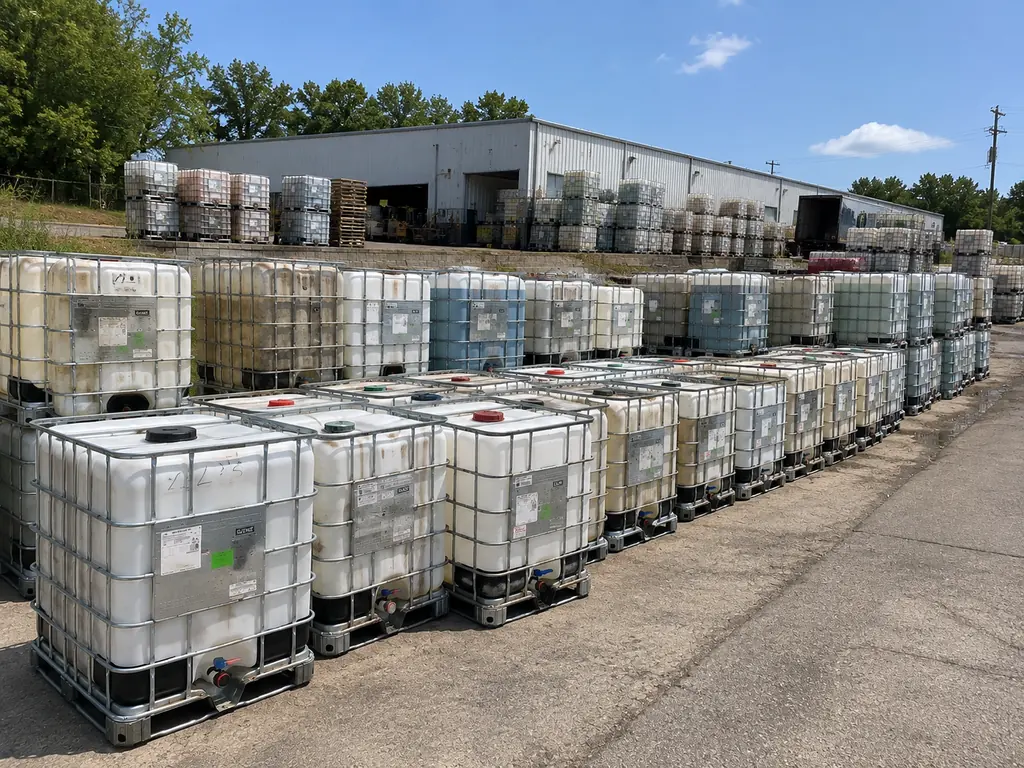
3505 Montopolis Drive is a single site with an intake and grading yard, four wash bays running a three-stage water recovery loop, a cage-squaring jig and rebottling line, an on-site granulator and steel baler, and a fabrication shop. Four trucks run from it. Roughly forty thousand containers pass through each year, and about eighty-three percent of them go back out as containers rather than as raw material.
01The walk
In the order a container experiences them, from the gate to the wrapping station.
Every container is read before it is unloaded: original shipping label, UN data plate, residue. No label and no identifiable residue means the container can never be sold as food grade, whatever it looks like. We have turned loads away at this gate and we will again.
Ball valve, dust cap, gasket and lid come off. About a third of valves are rebuildable; the rest are replaced. Gaskets are never reused — they are porous, absorbent and cost four dollars.
Four levels: triple rinse, hot alkaline detergent at 160 °F through a spray ball, recirculating caustic CIP, and live steam. Food work runs at the start of a shift on a flushed line, never behind chemical work.
Three stages. The final rinse of one container becomes the first rinse of the next, solids settle and are skimmed, and roughly 68 percent of the water goes round again. Fresh consumption drops from about 34 gallons per container to about 11.
Diagonals measured, bent tubes pressed back, cracked joints re-welded and cold-galvanised. A cage that passes here has four to eight service lives ahead of it.
Old bottle cut free and sent to the granulator, new virgin bottle dropped, seated and clamped, all new fittings. Around a hundred units a week when bottle stock allows.
Water fill, hold at working pressure with the valve open and shut, lid seal check. Then grading against the nine-point standard, photography, lot number and wrap. The photographs are what customers see before they approve a load.
End of the line. Bottles and composite pallets granulated to 3/8-inch regrind for pipe, pallet and drainage manufacture; cages sheared and baled for an electric arc furnace on the Gulf Coast. About 96 percent of the mass recovered.
Cutting, hot-air plastic welding, bulkheads, manifolds, frames, sight gauges, heat jackets and branding. Prototypes jump the queue because most production runs start as one.
02Capacity
Fourteen thousand square feet of roof feeds an eight-tote harvesting array built entirely from C-grade stock — screened inlets, first-flush diverters, bottom-linked with isolation valves, shaded against algae. In an average year it supplies about a fifth of the wash line’s feed water.
It is also the best sales demonstration we own. Customers ask about it more than anything else on the tour, and several have gone home and built one. That is a better outcome than most marketing.
03Water
| Stage | Fresh water | Recovered | Notes |
|---|---|---|---|
| L1 triple rinse, no loop | 34 gal | 0 | The naive number |
| L1 triple rinse, with loop | 11 gal | 23 gal | 68 % recovery |
| L2 hot detergent | 18 gal | 31 gal | Heated, then cascaded down |
| L3 caustic CIP | 26 gal | 44 gal | Neutralised before discharge |
| L4 steam finish | 9 gal | — | Condensate recovered where practical |
A wash line is the least green part of a recycling business if you run it carelessly. Publishing the balance is how we keep ourselves honest about it.
?Questions
Yes, and we give a lot of these. Ask on the form with a couple of dates. Tours run about forty minutes and cover intake and grading, the wash line, the rebottling jig, the granulator and the rainwater array. Closed-toe shoes, and we will lend you glasses and a vest.
Through a three-stage recovery loop first — the final rinse of one container becomes the first rinse of the next. Solids are settled and skimmed. Only the concentrated fraction leaves as trade effluent under permit, and recovered solids are rendered or landfilled according to their waste code.
Yes. It is the least profitable machine here and the one we are proudest of, because owning it is why we can name a destination on a diversion certificate rather than saying 'a recycler took it'.
About 260 containers a week at wash levels 1 and 2, about 140 at levels 3 and 4, plus roughly 100 rebottles depending on bottle stock. Intake capacity is higher than processing capacity, which is why we schedule large fleets in blocks.
◆On the yard
»Keep reading
Four levels, documented records, per-unit pricing.
Seventeen years, including the year we got it wrong.
Wash line, drivers and inside sales.
One form, one human, one written quote. Totes to buy, totes to sell, a wash job, a recycling pickup — it all starts here.