IBC Totes TXReclaim · AustinGet a quote
Navigate the yard

Austin Yard

3505 Montopolis Dr, Austin, TX 78744
hello@ibctotestx.com

29 terms

The words
of the trade

Container people use a private vocabulary and then wonder why buyers order the wrong thing. Here it is in plain English, with the practical consequence attached to each definition rather than left implied.
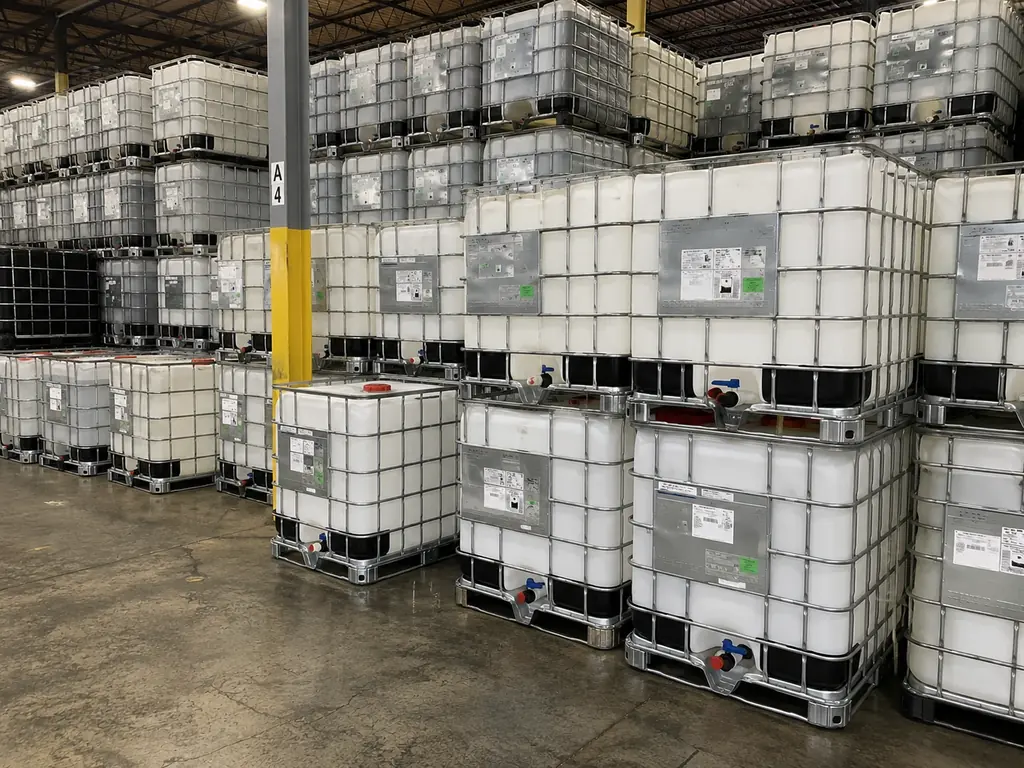
IBC totes stacked two and three high inside a warehouse, filling the frame in long rows either side of an aisle

Order desk

Term missing?

If something we said on a quote made no sense, tell us the word and we will both define it here and stop using it without explanation.

A working address — the quote comes back here.

US or Canada only, in the format (XXX) XXX-XXXX.

US state or Canadian province — name or two-letter code.

US ZIP (XXXXX or XXXXX-XXXX) or Canadian postal code (A1A 1A1).

26 totes fill a 53-foot trailer single-stacked.

Quotes are written by a human in the Austin yard, usually the same day. We never sell or share what you send us.

The five words that matter most

Bottle and cage are the two halves of a composite IBC and they age at completely different rates, which is the whole basis of rebottling. Tare is the empty weight and it decides your truckload. Prior contents is the fact that determines grade, price and legal use. Stacking load is on the data plate and is not the same number as gross mass — confusing the two is how stacks fail.

A–VDefinitions

Glossary

Bottle
The blow-moulded HDPE inner receptacle of a composite IBC. It is the part that touches your product, the part that carries prior contents, and the part that retires first — typically after one to three service lives against the cage's four to eight.

See also: Cage, Rebottling

Buttress thread
The coarse, asymmetric thread form used on IBC outlets, designated S60×6 (60 mm nominal, 6 mm pitch) or S100×8 for large outlets. Designed to seal under load with a flat gasket rather than by thread interference.
Cage
The welded galvanised steel tubular frame surrounding the bottle. It carries all stacking and handling load, and it is essentially inert — cages die from forklift strikes, not from age.
Camlock
A cam-and-groove quick-connect coupling, types A through F. The standard way to get from an IBC outlet to a hose without threading anything. Type C (female coupler with hose shank) and type F (male adapter with male NPT) cover most IBC work.
CIP
Clean-in-place. Cleaning a vessel by recirculating hot detergent or caustic through a spray device without dismantling it. The only practical way to properly clean an IBC, given that a 6-inch lid offers no arm access.
Creep
The slow permanent deformation of a polymer under sustained load. In HDPE the rate roughly doubles for every 20 °F rise in temperature, which is why a tote stack that is stable in the morning can be spreading by mid-afternoon on a hot slab.
Data plate
The metal or moulded plate on the cage carrying the UN packaging code, manufacture date, stacking load, maximum gross mass and hydraulic test pressure. The closest thing an IBC has to a birth certificate.

See also: UN 31HA1

First flush
The initial runoff from a roof at the start of a rain event, carrying the accumulated dust, pollen, bird droppings and grit. A first-flush diverter captures and discards roughly the first two gallons before storage — the single highest-value component in a rainwater system.
Food grade
A provenance claim, not a cleanliness claim: one prior fill, that fill was an edible product, and there is documentation naming it. No cleaning process converts an industrial tote into a food grade one, because absorbed contaminants live inside the polymer rather than on it.
Gasket
The elastomeric seal between the valve and the bottle outlet, and the seal in the lid. Available in EPDM (water, caustics, alcohols), Viton/FKM (fuels, oils, solvents), silicone (food, heat) and Buna-N (petroleum oils). The most common cause of a 'leaking tote' is the wrong gasket material, and it is a four dollar fix.
GMA pallet
The 48 × 40 inch pallet footprint standard in North American grocery and general distribution. IBC totes from 110 to 350 gallons all share it, which is why a 330 drops straight into a 275's rack position.
Gross mass
The maximum permitted total weight of a filled container, stated on the data plate. Distinct from — and routinely confused with — the stacking load, which is what may be placed on top of it.

See also: Stacking load

HDPE
High-density polyethylene, resin identification code 2. The material of every IBC bottle. Excellent with water, caustics, acids, alcohols and detergents; poor with aromatic solvents, chlorinated solvents and strong oxidisers. Semi-crystalline and slightly permeable, which is why absorbed odours never fully leave.
IBC
Intermediate bulk container. A reusable container sized between a drum and a bulk tank, typically 275 or 330 gallons, designed for forklift handling and stacking. 'Tote' is the same thing in North American usage.
LTL
Less-than-truckload freight, priced per pallet position rather than by weight. Because totes cube out long before they weigh out, LTL is expensive per unit and rarely economic below six containers.
Nominal capacity
The rated working volume of a tote, distinct from brimful capacity. A '275 gallon' tote physically holds about 290 gallons; the difference is headspace for thermal expansion and it should not be filled into.
Packing group
The hazard tier a packaging design was tested against, marked on the data plate as Y (covers packing groups II and III) or Z (III only). Relevant to regulated transport, irrelevant to on-site storage.
Rebottling
Fitting a new virgin HDPE bottle into a reclaimed, straightened steel cage. Produces a container with no prior contents at roughly 60 percent of a new tote's price and 45 percent of its embodied carbon. The old bottle is granulated rather than discarded.

See also: Bottle, Regrind

Reconditioning
Returning a used container to service: interior and exterior wash, cage straightening, valve rebuild or replacement, new gasket, leak test and re-grading. An unregulated term in the trade, which is why any serious yard publishes its actual process.
Regrind
Granulated post-industrial plastic, typically produced to 3/8-inch particle size, sold as feedstock for pipe, pallet and drainage manufacture. Carries roughly a quarter of the embodied carbon of virgin resin — good, but far worse than not granulating the container at all.
RTP
Rigid tote pallet — the integrated pallet base of an IBC, available in composite, all-plastic or steel. Composite is standard; plastic suits wash-down and no-metal environments; steel takes forklift abuse and heat.
Spray ball
A fixed or rotating nozzle lowered through the lid to distribute cleaning solution across the interior wall. The correct tool for interior cleaning — as opposed to a turbo pressure-washer nozzle, which permanently scores the wall.
Stacking load
The maximum weight that may be placed on top of a filled container, stated in kilograms on the data plate. A rating of zero means the container is not designed to be stacked at all. Not the same as gross mass.

See also: Gross mass

Tare
The weight of the empty container. About 127 lb for a 275 gallon composite tote and 136 lb for a 330. Subtract from gross to get net product weight, and remember it when calculating a truckload.
Tote
North American usage for an IBC. Interchangeable in every practical sense, though 'tote' tends to imply the 275/330 gallon composite type specifically.
Triple rinse
Three separate fills of roughly ten percent volume, agitated and fully drained between each, with the valve open during at least one so the outlet dead leg is flushed. The baseline wash level, adequate for water-soluble residues.
UN 31HA1
The UN packaging code for a composite IBC with a rigid plastic inner receptacle and a steel outer casing, intended for liquids filled and discharged by gravity. 3 = IBC, 1 = composite, H = plastic inner, A = steel outer, 1 = liquids by gravity.

See also: Data plate

UV embrittlement
Degradation of HDPE by ultraviolet light, visible as a chalky white surface bloom and a loss of impact strength. Three uncovered Texas summers will do it. Shade, a cover or a black pigmented bottle prevents it; nothing reverses it.
Valve, restricted flow
A ball valve with a reduced bore, used where full-bore discharge would be unsafe or where dosing accuracy matters more than speed. Costs a few dollars more and prevents a specific category of accident.

On the yard

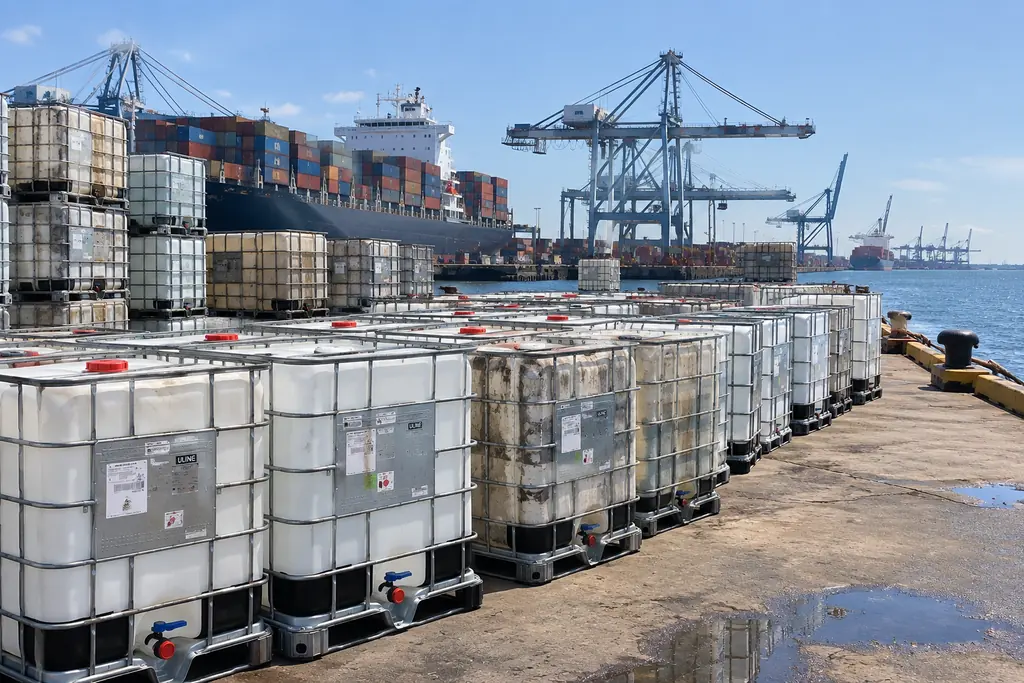
A long line of used IBC totes on a quayside with container cranes and a cargo ship in the background
The Gulf corridorShip-channel intake. The petrochemical corridor generates more used containers than anywhere else in Texas.
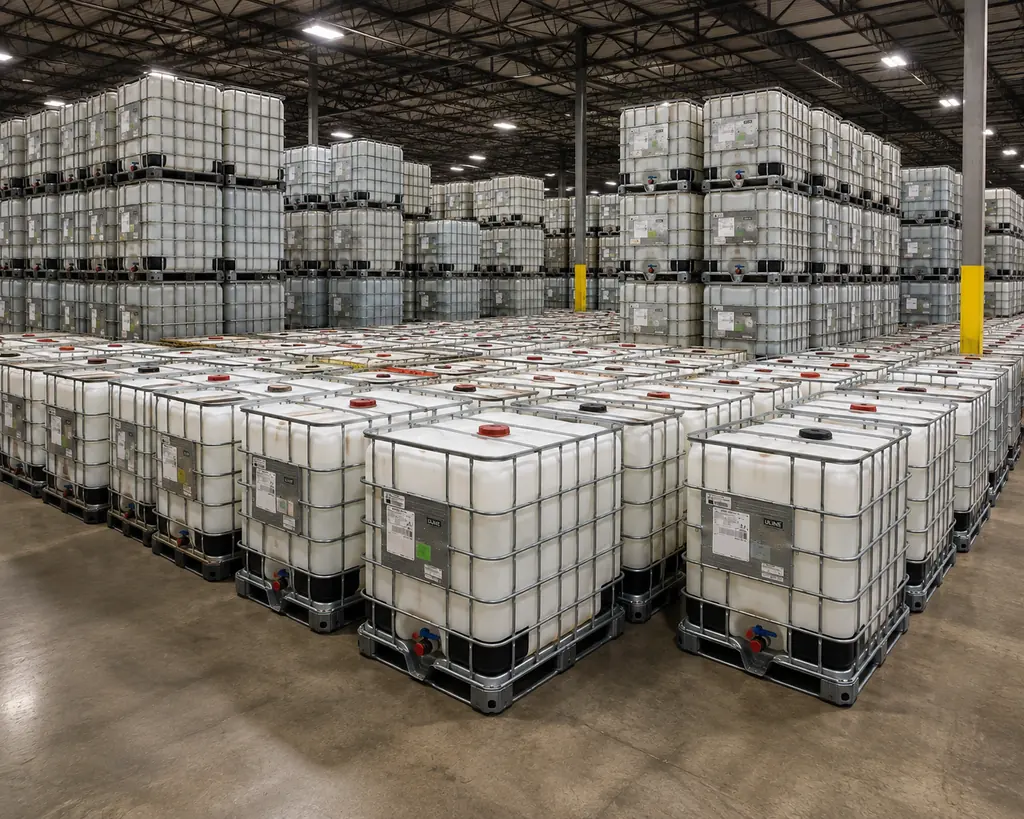
A wide view down a warehouse filled with hundreds of IBC totes stacked in rows under overhead lighting
The floorRoughly forty thousand containers pass through the yard each year. Around 83 % leave as containers.

»Keep reading