Cleaning a tote yourself
What you can do on site, and the limits of a 6-inch lid.
Service 02 · The wash line
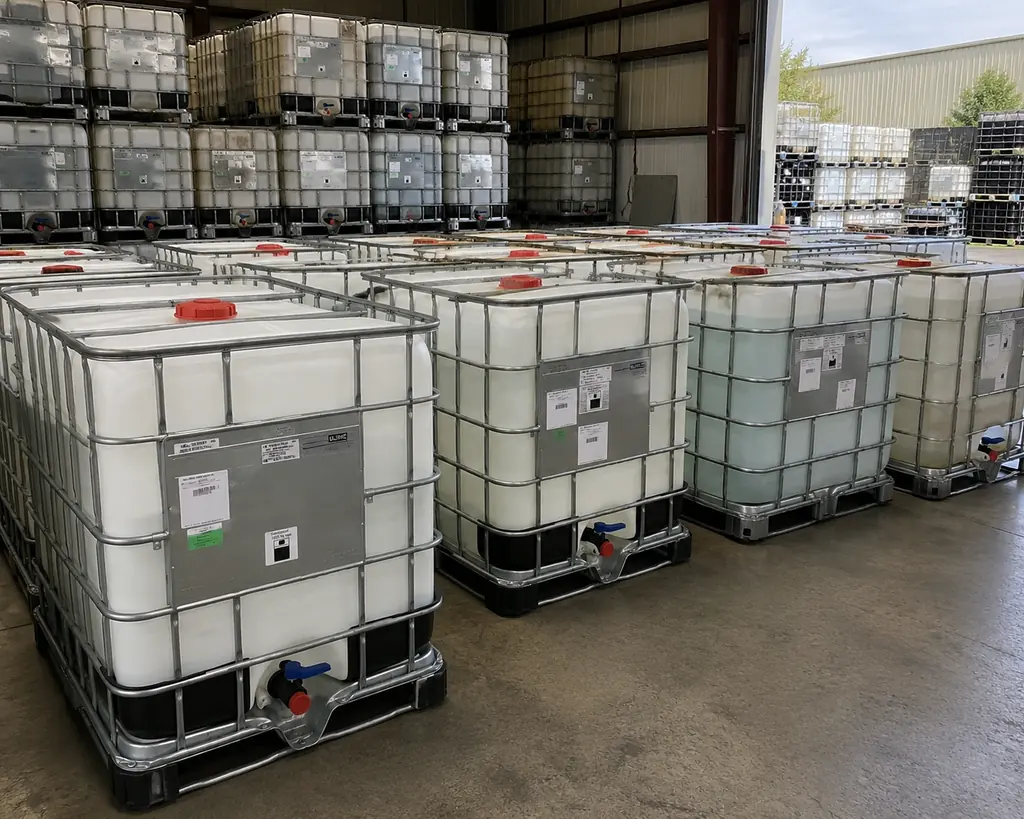
If you own your fleet, you do not need to buy containers — you need someone to make the ones you have fit to fill again. Our wash line does that on a per-unit basis with a documented record for each container.
Order desk
Counts, ZIP and what the containers last held. That is enough for us to come back with a real number rather than a range.
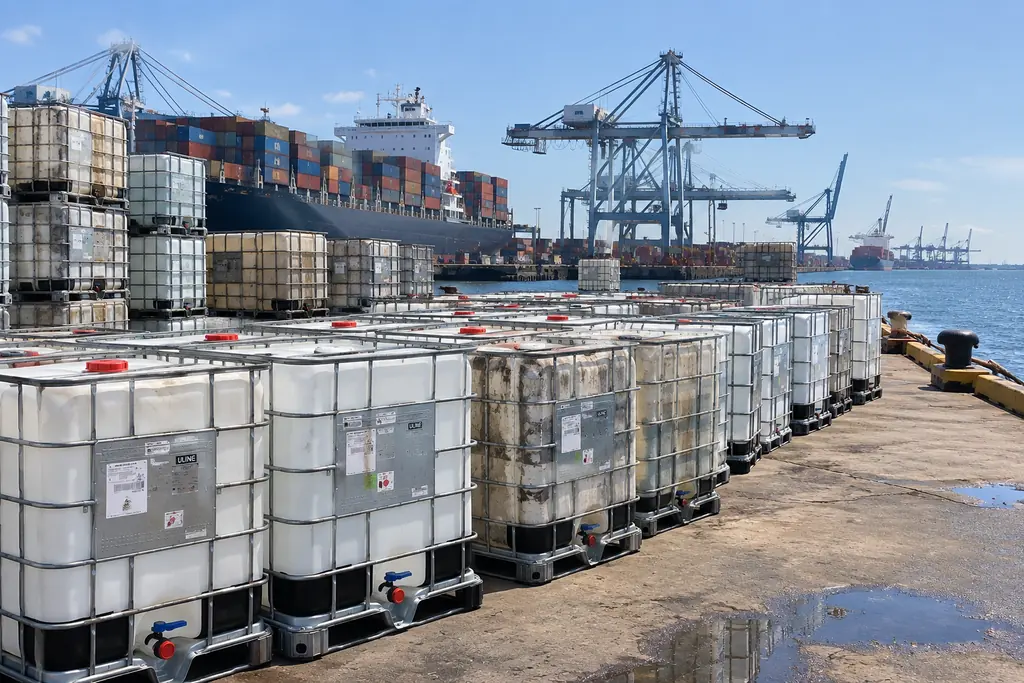
We recondition customer-owned IBC totes on a per-unit basis: interior wash to the level your product requires, exterior wash and de-labelling, cage straightening, valve rebuild or replacement, leak test and a written wash record per lot. Typical turnaround is three business days for stock quantities. Pricing runs $22–$78 per unit depending on wash level and the state they arrive in.
| Level | Method | Removes | Indicative price |
|---|---|---|---|
| L1 — Triple rinse | Three ambient potable rinses, drained between | Water-soluble residues, dilute salts | $22–$32 |
| L2 — Hot detergent | 160 °F wash with alkaline detergent, spray ball, potable rinse | Light oils, soaps, sugars, most food residues | $34–$48 |
| L3 — Caustic CIP | Recirculating hot caustic, timed cycle, neutralising rinse | Heavy oils, adhesives, polymer films, set sugars | $48–$66 |
| L4 — Steam finish | L3 plus live steam with vented lid, controlled cooldown | Odour, biofilm, residual volatiles | $62–$78 |
The most common mistake is buying too much wash. If your next fill is the same product as the last fill, L1 is usually all you need and the rest is money spent on making a tote look nicer than it needs to. Tell us what came out and what goes in and we will specify the cheapest level that works.
A wash line is the least green part of a recycling business if you run it carelessly. Ours runs on a three-stage recovery loop: the final rinse of one tote becomes the first rinse of the next, solids are settled and skimmed, and only the concentrated fraction leaves as trade effluent under permit.
?Common questions
Usually, but send the SDS first. There are products we will not put through the line at any price — anything that would contaminate the recovery loop, anything listed hazardous, and anything whose residue we cannot safely neutralise. We will tell you within an hour of seeing the sheet.
The line runs about 260 units a week at L1–L2 and about 140 at L3–L4. Large fleets are scheduled in blocks so your units come back together rather than dribbling out.
Yes, on a segregated schedule at the start of a shift on a clean line, with potable feed water and a food-grade sanitiser. Food work never follows chemical work on the same day without a full line flush, and the record shows it.
Almost always, if your cages are sound. A wash and rebuild at $34 against a $130 reconditioned purchase is not a close call. The maths only flips when your fleet is old enough that half of it fails inspection.
»Keep reading
What you can do on site, and the limits of a 6-inch lid.
Rebottling a sound cage costs less than you think.
A walk through the bays, the loop and the granulator.
One form, one human, one written quote. Totes to buy, totes to sell, a wash job, a recycling pickup — it all starts here.