275 gallon totes
1,000 L on a GMA footprint. The default.
70 % of our stock
Reference
Every capacity, footprint, height, tare and gross weight we handle, in one table you can work from. Plus the load-planning arithmetic that actually decides your landed cost.
Order desk
Tell us the rack beam opening, the door height or the product density you are working with and we will tell you which size fits — before you order, not after.
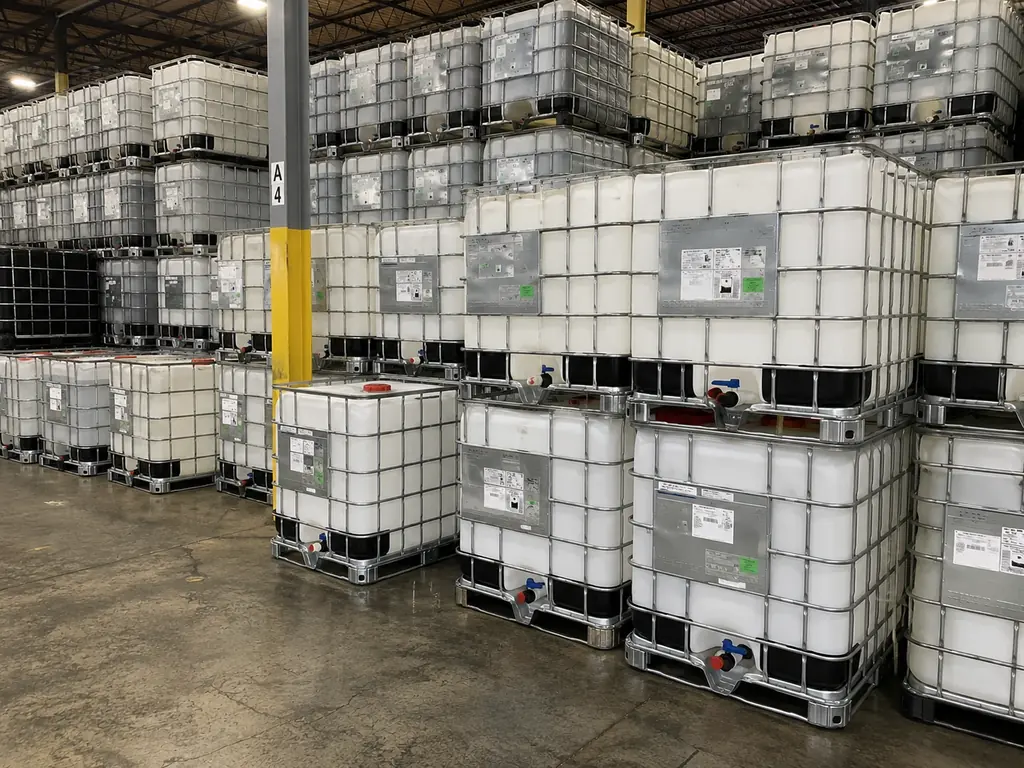
IBC totes come in nine common capacities from 110 to 1,000 gallons. Everything between 110 and 350 gallons uses the same 48" × 40" GMA pallet footprint and differs only in height, so those sizes are interchangeable in a rack position as long as the beam opening allows. The 275 gallon (1,000 L) is the global standard; the 330 gallon offers 20 % more volume for seven extra inches of height, which makes it cheaper per gallon on every fixed cost in your supply chain.
01Master table
Tare and gross weights assume a composite pallet and water. For any other product, multiply the water weight by the specific gravity.
| Capacity | Litres | Footprint (L × W) | Height | Tare | Gross, water | Common use |
|---|---|---|---|---|---|---|
| 110 gal | 416 L | 48" × 40" | 30" | 84 lb | 1,000 lb | Low-headroom, half-height racking |
| 120 gal | 454 L | 40" × 32" | 35" | 78 lb | 1,080 lb | Compact dosing, lab and pilot |
| 180 gal | 681 L | 48" × 40" | 36" | 98 lb | 1,600 lb | Short cage, high-density product |
| 220 gal | 833 L | 48" × 40" | 42" | 116 lb | 1,970 lb | European legacy sizing |
| 275 gal | 1,041 L | 48" × 40" | 46" | 127 lb | 2,420 lb | The global standard workhorse |
| 330 gal | 1,249 L | 48" × 40" | 53" | 136 lb | 2,890 lb | Same footprint, 20 % more volume |
| 350 gal | 1,325 L | 48" × 40" | 56" | 148 lb | 3,070 lb | Tall build, less common |
| 550 gal | 2,082 L | 62" × 48" | 58" | 244 lb | 4,830 lb | Oversize, needs a dedicated position |
| 1,000 gal | 3,785 L | 80" × 60" | 72" | 460 lb | 8,800 lb | Site tank territory, not really an IBC |
02Detail pages
1,000 L on a GMA footprint. The default.
70 % of our stock
Same floor space, 20 % more product.
Better per gallon
Oversize and specialty volumes, sourced rather than stocked.
To order
Cube, gross weights, trailer counts, rack clearances and the freight arithmetic that decides what you actually pay.
Load planning
What A, B, C and R mean here, what each is honestly good for, and why grade matters more than size.
Grading
03Capacity conversions
| From | To | Value |
|---|---|---|
| 275 US gallons | Litres | 1,041 L |
| 330 US gallons | Litres | 1,249 L |
| 1,000 litres | US gallons | 264 gal |
| 275 gal of water | Pounds | 2,293 lb |
| 275 gal of water | Kilograms | 1,040 kg |
| 1 IBC tote (275 gal) | 55 gal drums | 5 drums |
| 1 US gallon of water | Pounds | 8.34 lb |
| 1 cubic metre | US gallons | 264 gal |
| 275 gal tote external | Cubic feet | ≈ 51 ft³ |
?Questions
275 US gallons (1,041 litres) on a 48 by 40 inch footprint, 46 inches tall. It is roughly seven out of every ten containers in circulation, and when somebody says 'a tote' without qualifying it, this is what they mean.
Everything from 110 to 350 gallons shares the 48 by 40 inch GMA pallet footprint — only the height changes. Above 350 gallons you leave the standard and containers stop fitting pallet positions and racking.
Multiply the nominal capacity in gallons by 8.34 lb (water) and by your product's specific gravity, then add the tare. A 275 gallon tote of 1.2 SG product is 275 × 8.34 × 1.2 + 127, which is about 2,880 lb.
A '275 gallon' tote physically holds about 290 gallons to the lid. The 15-gallon difference is headspace for thermal expansion. Filling into it is how a tote in a Texas parking lot in July lifts its lid or bulges its walls.
◆On the yard
One form, one human, one written quote. Totes to buy, totes to sell, a wash job, a recycling pickup — it all starts here.