IBC Totes TXReclaim · AustinGet a quote
Navigate the yard

Austin Yard

3505 Montopolis Dr, Austin, TX 78744
hello@ibctotestx.com

Service 06 · The bay at the back

Custom
fabrication

Half the interesting work in this yard starts as a phone photo and a sentence beginning "can you make one of these but…". The fabrication bay exists to answer that.
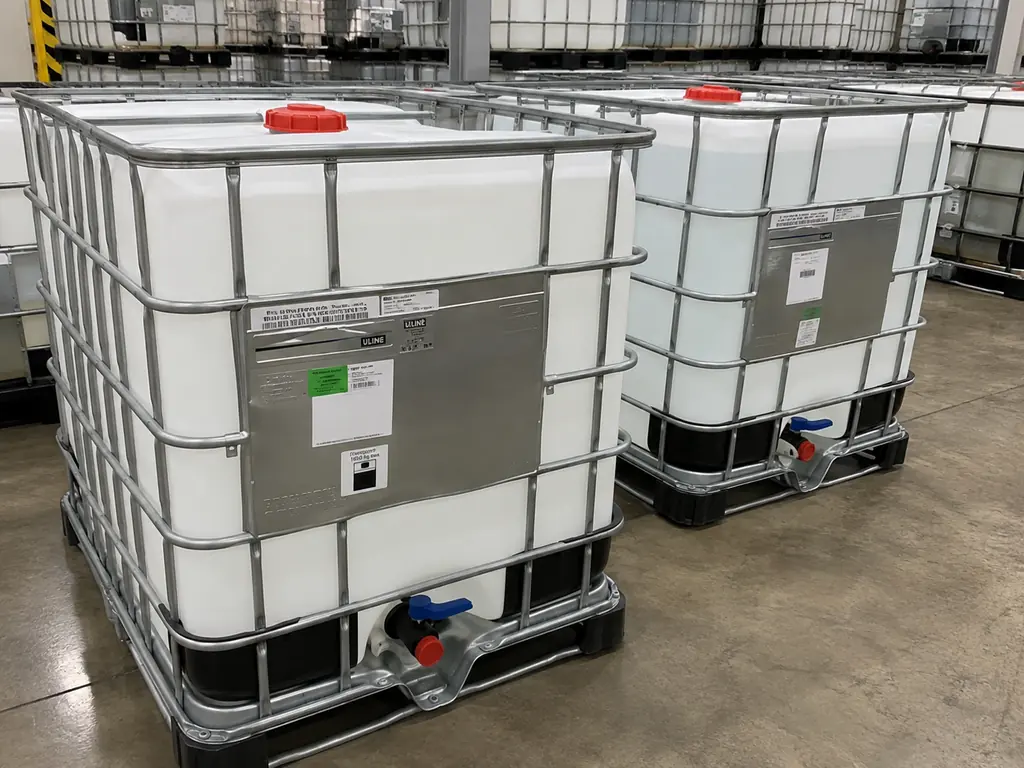
Two reconditioned 275 gallon IBC totes side by side on a warehouse floor, clear HDPE bottles in galvanised cages with red lids and blue ball valves

Order desk

Book this in

Counts, ZIP and what the containers last held. That is enough for us to come back with a real number rather than a range.

A working address — the quote comes back here.

US or Canada only, in the format (XXX) XXX-XXXX.

US state or Canadian province — name or two-letter code.

US ZIP (XXXXX or XXXXX-XXXX) or Canadian postal code (A1A 1A1).

26 totes fill a 53-foot trailer single-stacked.

Quotes are written by a human in the Austin yard, usually the same day. We never sell or share what you send us.

The short answer

We modify IBC totes to order: cutting and capping, bulkhead fittings, manifolded arrays, frame extensions and stands, insulation and heat jackets, secondary containment, agitator mounts, sight gauges, and stencilled or plated branding. Work runs from a single prototype to production batches, and everything is built on reclaimed containers unless you specify otherwise.
  • Cut, cap, bulkhead, manifold, gauge, agitate, insulate, frame, brand
  • One-off prototypes welcome — most production runs start as one
  • Built on reclaimed stock by default; new components where specified
  • Send a sketch, a photo or a dimension and we will quote from it
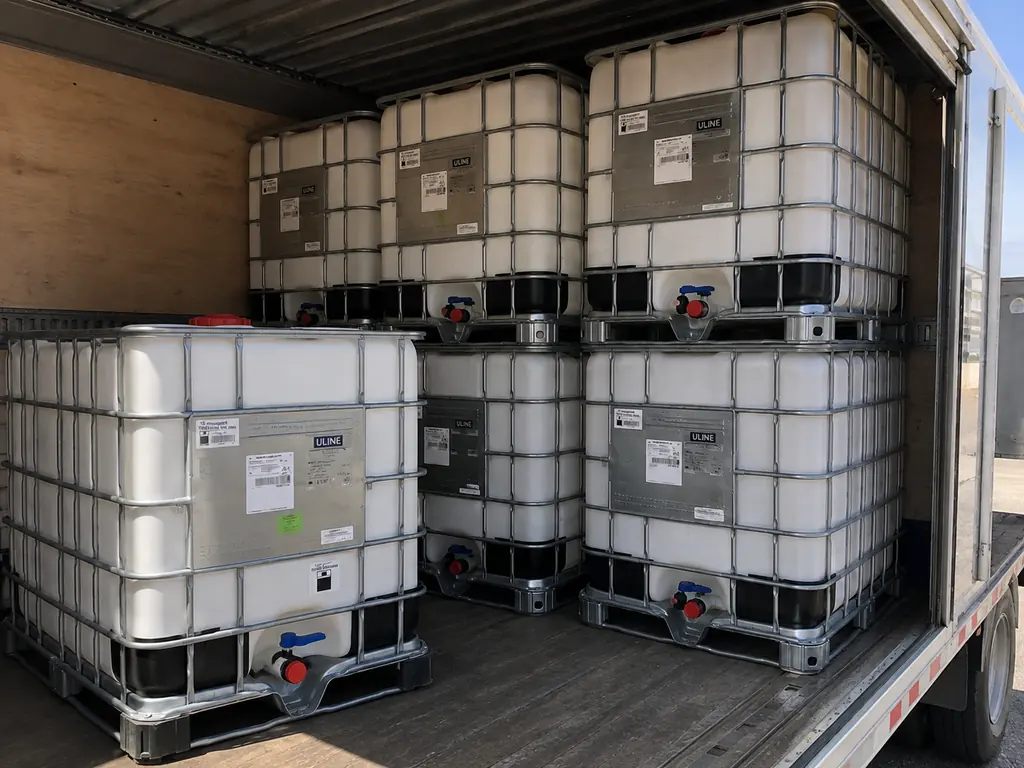
IBC totes loaded single-stacked inside a dry van trailer, strapped over the cage rails with the rear door open to blue sky
26 to a trailerSingle-stacked and strapped over the cage rail, never over the bottle. Valves loaded inboard.

What comes out of the bay

  • Manifolded arrays. Two to eight totes bottom-linked with a common draw point and isolation valves, so a site draws from one tap and fills from another.
  • Sight gauges. External tube gauges with a graduated scale, because guessing level through a hazed bottle is how people run pumps dry.
  • Agitator mounts. A cut lid plate and a braced frame for a drum-scale mixer, for anything that settles.
  • Heat jackets and insulation. Silicone blanket heaters, insulated covers and thermostat mounts for products that gel below 50 °F — a real problem in a Texas January and a real surprise to people who move here.
  • Frames and stands. Cut-down cage stands from 12 to 48 inches, giving gravity head for drip irrigation or bucket clearance for decanting.
  • Secondary containment. Bund pallets and welded steel trays rated to 110 % of a single tote.
  • Branding. Stencilled cages, plated asset tags, colour-coded valve handles for multi-product sites.
  • Cut and cap. Open-top conversions, split beds, hatch cuts and hinged lids.

How a custom job runs

  1. Send anything: a sketch on a napkin, a phone photo of the thing you are trying to replace, a dimension, a CAD file. All four have started jobs here.
  2. We come back with a fixed price and a build note describing what we understood — read the build note carefully, that is where misunderstandings live.
  3. Prototype if the run is over ten units. You approve the first one before we build the rest.
  4. Build, test and photograph. Anything holding liquid gets the same leak test as a resale tote.
  5. Delivery on our own trucks, or collection from the yard.
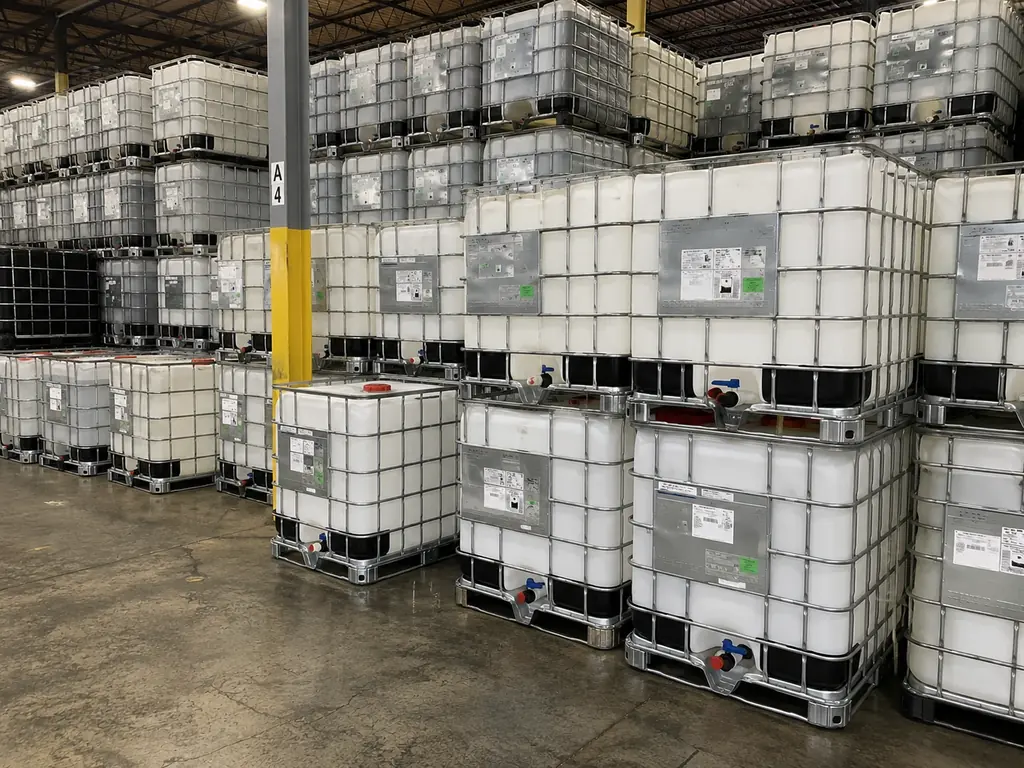
IBC totes stacked two and three high inside a warehouse, filling the frame in long rows either side of an aisle
Two high filledTwo high filled is the ceiling. Three high is empties only — HDPE creeps under sustained load.
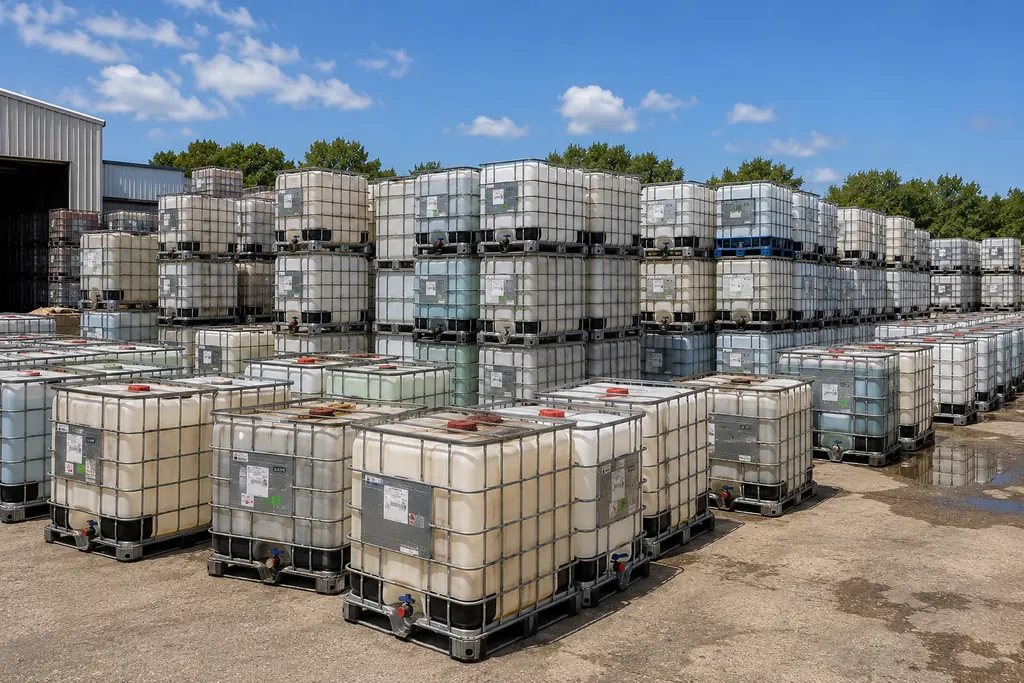
An outdoor container yard under a blue sky, with IBC totes stacked several high in long rows across a gravel lot
Outdoor storageThree Texas summers uncovered will chalk a bottle. Shade is the cheapest life extension there is.

?Common questions

Questions people actually ask

Can you cut a tote for me if I supply it?

Yes. Customer-supplied containers are fine as long as we can identify the prior contents. We charge for the work only, and we will refuse anything whose history we cannot establish.

How much does a manifolded array cost?

A four-tote bottom-linked array with isolation valves, a common draw and a frame runs roughly $1,100–$1,900 depending on the container grade and the valve specification. It is almost always cheaper than a single tank of the same volume, and it dismantles for transport.

Do you weld plastic?

We hot-air weld HDPE for bulkheads, patches and hatch collars. It is a real repair, not a hack — but a welded bottle is not a pressure-rated container and we will not certify it as one.

What is the lead time?

One to two weeks for most jobs, longer if a specified component has to come in. Prototypes are usually quicker because they jump the queue.

»Keep reading