IBC Totes TXReclaim · AustinGet a quote
Navigate the yard

Austin Yard

3505 Montopolis Dr, Austin, TX 78744
hello@ibctotestx.com

Guide · Practical

Safe handling
& stacking

A filled tote weighs about the same as a small car and holds a liquid that wants to leave. Almost every serious incident we hear about traces back to four causes, and all four are cheap to prevent.
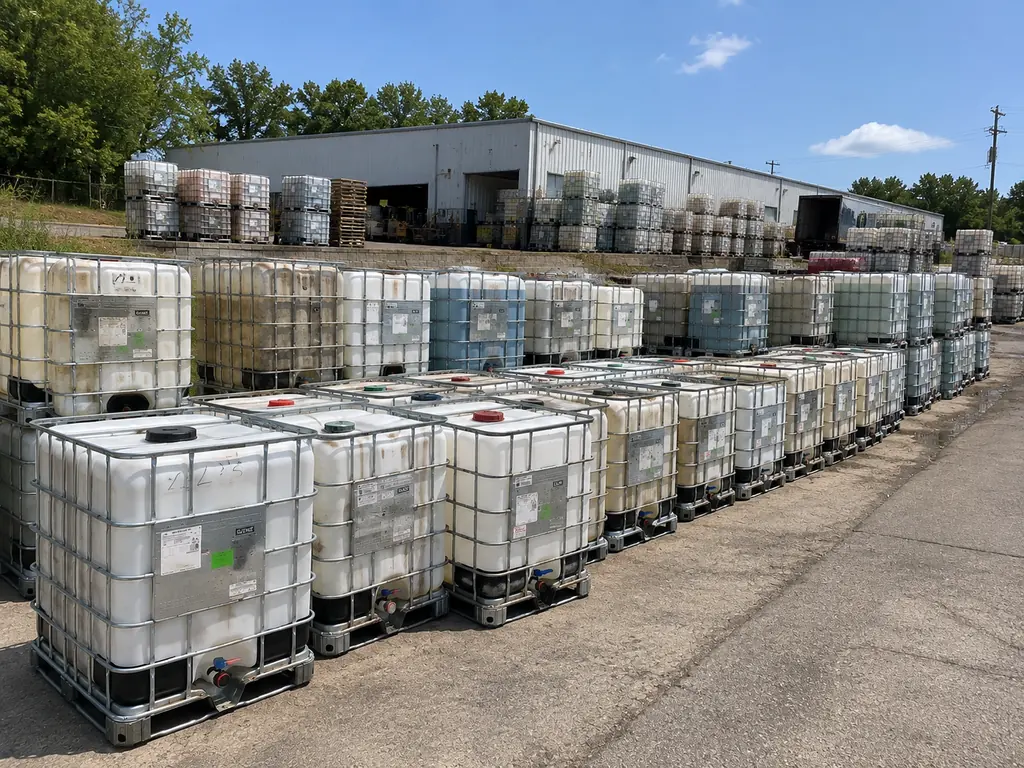
Weathered and discoloured used IBC totes lined up outdoors in front of a warehouse, showing a range of staining and cage condition

Order desk

Got a container question?

Reading this because you are working something out? Send it over. We answer questions from people who are not buying anything, and we do it in writing.

A working address — the quote comes back here.

US or Canada only, in the format (XXX) XXX-XXXX.

US state or Canadian province — name or two-letter code.

US ZIP (XXXXX or XXXXX-XXXX) or Canadian postal code (A1A 1A1).

26 totes fill a 53-foot trailer single-stacked.

Quotes are written by a human in the Austin yard, usually the same day. We never sell or share what you send us.

The short answer

The four failure modes are: overstacking (never more than two high filled, and never on a warm day with a soft product), forklift strikes (enter from the pallet side, slowly, and fit guards on exposed corners), static discharge during filling of flammable liquids (bond and ground, or use a conductive container), and inadequate secondary containment (bund to 110 % of the largest single container). Get those four right and the rest is housekeeping.
  • Two high filled is the ceiling — check the stacking load on the data plate
  • The forklift kills more cages than age ever will
  • Flammable liquid + plastic tote + no bonding = a real ignition risk
  • Bund to 110 % of the largest container, not 110 % of one tote's worth
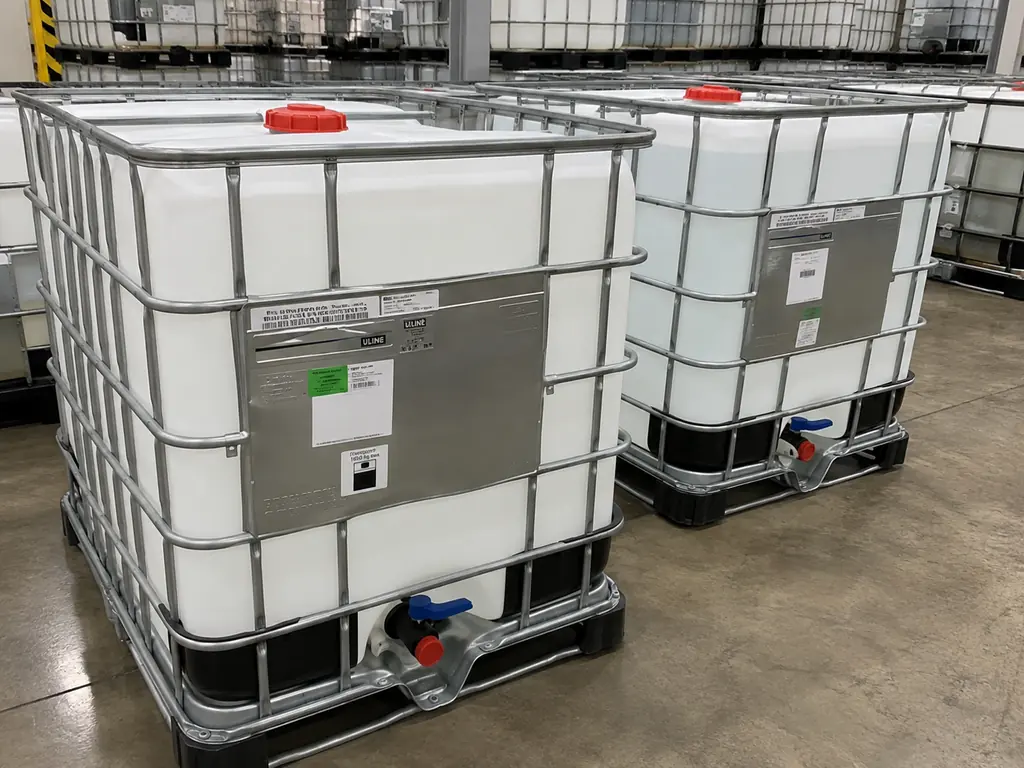
Two reconditioned 275 gallon IBC totes side by side on a warehouse floor, clear HDPE bottles in galvanised cages with red lids and blue ball valves
Graded and readyTwo 275 gallon units off the sales row — washed, new gaskets, valves rebuilt, photographed before they ship.

Stacking, and why the third layer fails

HDPE creeps. Under sustained load it deforms slowly and permanently, and the rate roughly doubles for every 20 °F of temperature rise. A stack that is stable on a 60 °F morning can be spreading by mid-afternoon on a 100 °F slab, and the bottom bottle bulges until the cage bars cut into it.

  • Two high filled, maximum, and only if the data plate's stacking load allows it.
  • Three high empty in the yard, on level ground, out of wind.
  • Never stack filled totes of different sizes. The load paths do not line up and the cage corner posts must carry the load, not the bottle.
  • Never stack on soft or uneven ground. A tilted stack concentrates load onto two corner posts.
  • Check stacks after a hot day. Creep is visible if you look for it — bulging at the bottom third is the warning sign.

Forklift discipline

Look at the scrap row of any tote yard, ours included, and count the causes of death. Forklift damage will beat every other cause combined. The bottle is protected by the cage from most things; it is not protected from a tine driven through the side.

  1. Enter from the pallet entry side only. Composite pallets are four-way but the bottle sits closer to the deck on two of those sides.
  2. Full fork depth, every time. A half-engaged tote pivots.
  3. Travel with the load low and tilted back. A filled tote has a high centre of gravity and it will not forgive a fast turn.
  4. Fit corner guards on any tote parked in a traffic aisle. They cost a few dollars and they save cages.
  5. Never lift a filled tote by the cage top rail. It is not a lifting point and it will bend.

Static, flammables and the thing people forget

A plastic IBC filling with a non-conductive flammable liquid accumulates static charge on the liquid surface and in the container wall. Standard HDPE cannot dissipate it. The discharge, when it comes, arrives in a vapour space that may be within its flammable range.
  • Use a conductive or antistatic IBC for flammable liquids. This is what they exist for.
  • Bond and ground the filling assembly, and use a dip pipe so the liquid does not free-fall and splash.
  • Control the fill rate. Fast splash filling is what generates the charge.
  • Standard poly totes are for non-flammables. If your product has a flash point you should be reading its safety data sheet, not this page.
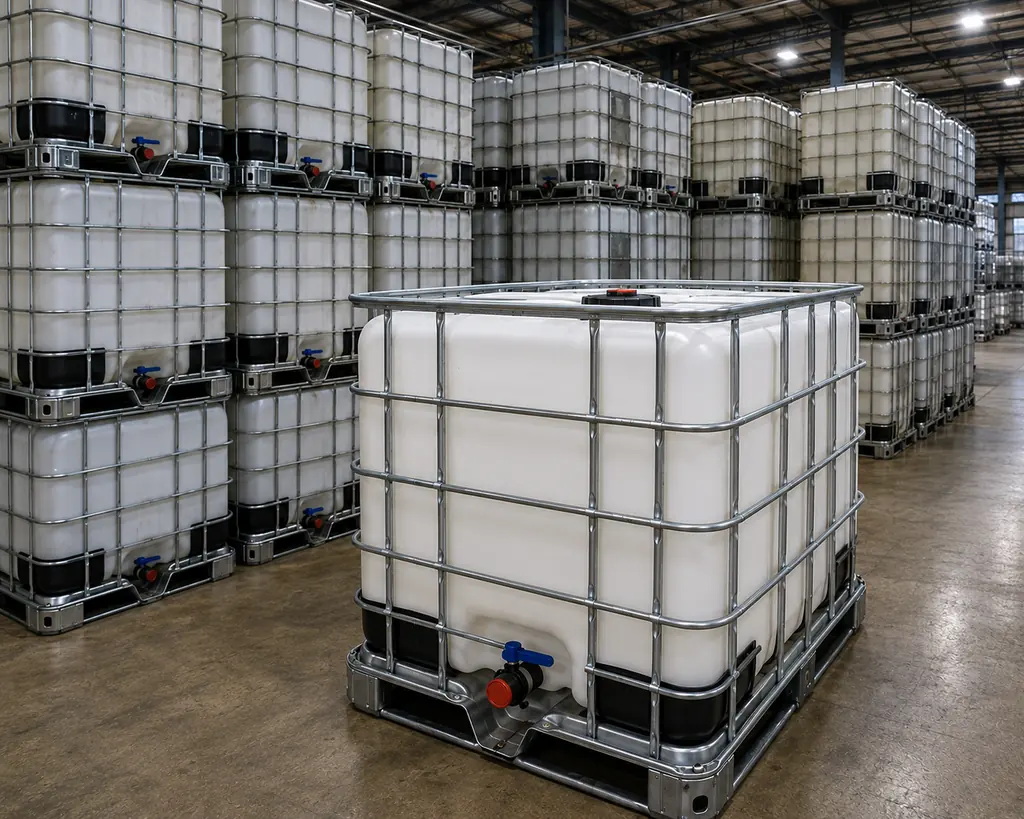
A single clean reconditioned IBC tote in the foreground of a warehouse, with stacks of further containers receding behind it
One container, eight livesA well-managed container sees four to eight service lives. The cage usually outlives three bottles.
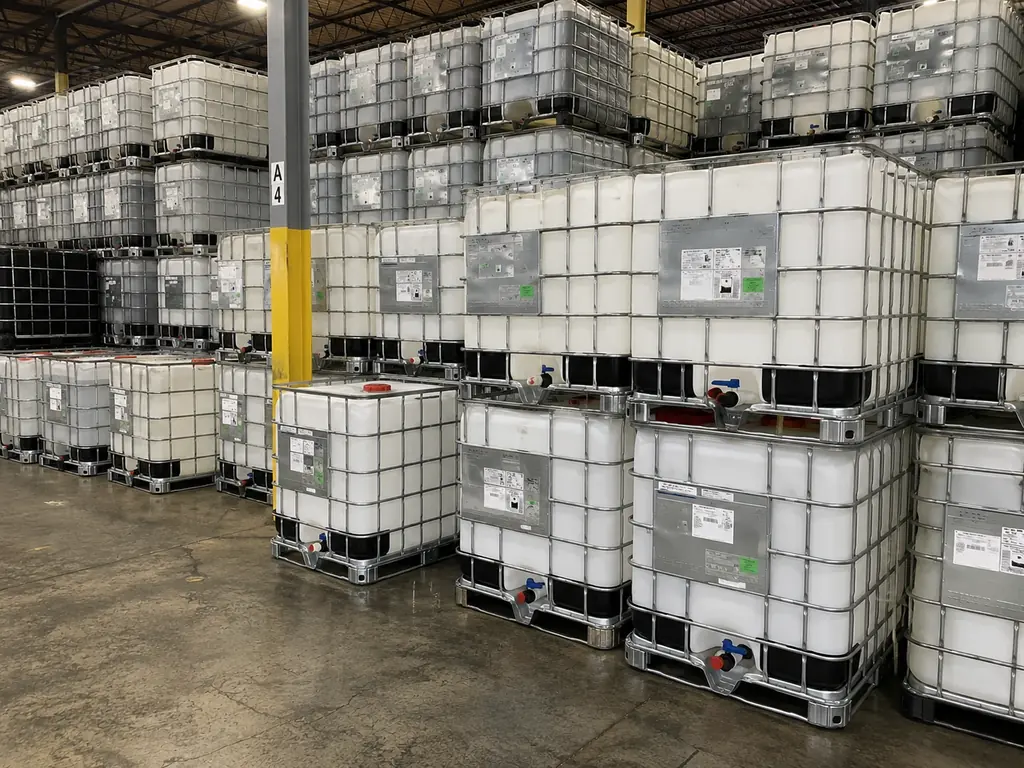
IBC totes stacked two and three high inside a warehouse, filling the frame in long rows either side of an aisle
Two high filledTwo high filled is the ceiling. Three high is empties only — HDPE creeps under sustained load.

?Common questions

Questions people actually ask

How high can I stack empty IBC totes?

Three high on level ground, out of the wind, and secured if you are in a hurricane-exposed area. Empty totes are light enough that wind is a genuine hazard — we strap our own yard stacks for exactly that reason.

Can I move a full tote with a pallet jack?

On smooth level concrete, with a jack rated well above 2,500 lb, slowly. On anything uneven, no. The wheels concentrate load and a jack that stalls halfway with 2,400 lb on it is a difficult situation to recover from safely.

Do I need a spill pallet?

If the product would be a problem on your floor, on your neighbour's floor or in the storm drain, yes. Local requirements vary and your own insurer often has opinions stronger than the regulations. It is a cheap thing to over-specify.

What temperature can an IBC tote handle?

Roughly −0.4 °F to 140 °F for sustained service, with about 175 °F as a short-duration ceiling for cleaning. Both ends move depending on the product inside — check compatibility, not just temperature.

»Keep reading